Neil Taft’s TEDx Airlie Talk – May 15
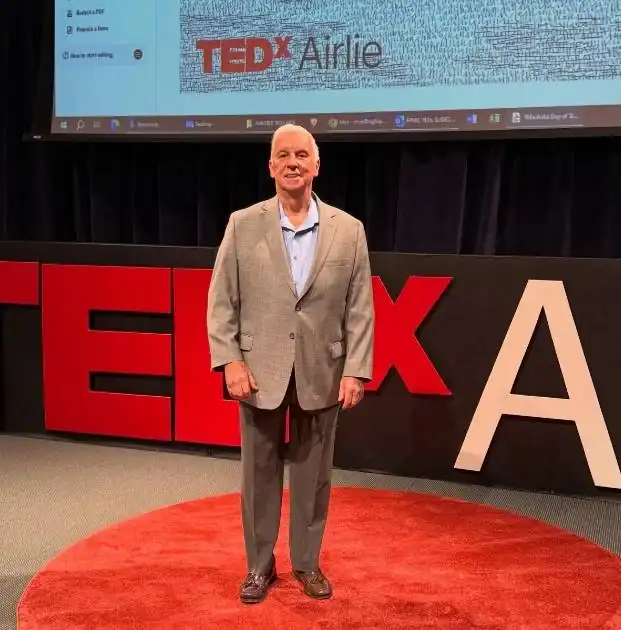
On May 15, I had the privilege of taking the stage at TEDx Airlie to share a message that has been building inside me for over 20 years. What I delivered that day was the distilled weight of 80+ years of lived experience, five books, and one urgent conviction: that the families who give their grandchildren the most aren’t the ones without conflict – they’re the ones who choose connection anyway. Here is that talk, in my own words.
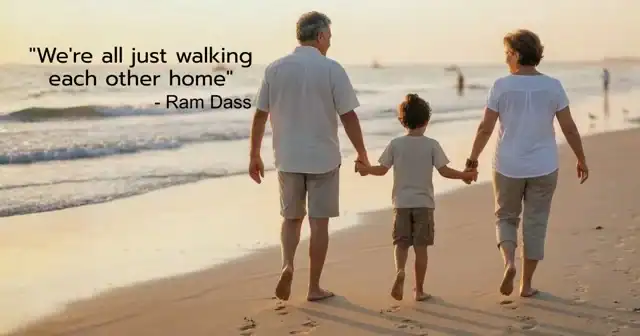
I invite each of you to consider the words of Ram Dass in the context of your own family.
“We’re all just walking each other home.”
I have been blessed to have walked further than almost everyone in this room.
I am a Grandpa of 7, Great-Grandpa of 6, and Great-Great-Grandpa of 2. All 15 of my grandchildren are still very much a part of my life.
This doesn’t just happen.
My particular area of expertise is grandparenting. It was in my pursuit of this subject that I uncovered a troubling and growing crisis.
There exists an upward trend in the number of families where grandparents are not automatically included in the lives of their grandchildren – the way they once were, the way we were included in our grandparents’ lives.
This broke my heart. It also inspired me to do something about it.
Fast forward 20 years, five books later – and now I am searching for family leaders.
I am on a mission to help this and future generations of grandkids get what they deserve.
More love, not less.
On this journey, I have learned a thing or two.
Like this: “Life is complicated. Family life is a multiple of complicated. And extended family life is exponentially complicated.”
Often, labeling something “complicated” is just another way of saying: “I don’t want to talk about it.”
The thing about complexity – especially when it comes to our extended families – is that it is hard. It is genuinely, legitimately hard.
My goal today is to invite each of you to think more deeply about family. Specifically your family, and how it functions.
Our families – and our extended families – are inhabited by many people we didn’t have much of a say in choosing. Yet family is crucial to so much of who we are and how we live.
Let’s dwell for a moment on just how crucial this family deal really is.
Please raise your hand if you have zero drama or trauma in your immediate family.
…
Now extrapolate that to your extended family – and you’ll begin to see where I’m going with this.
It is my hope that each person here today will take away an awareness of just how important your family is – messy and all.
Because the lens through which you see every relationship in your life is colored by your early childhood experiences, your ongoing perceptions, and the family you grew up inside.

Tony Robbins calls it your blueprint for life. Are we stuck with it?Fortunately – no.This choice – and it is a choice – is entirely yours.In the name of family, let’s start the only place we ever can: right where we are now.
There is one requirement for the family leaders I am looking for. And I won’t pretend it’s easy.
You must be willing, temporarily, to put your ego in your back pocket.
This is not an exercise in being right. It is an exercise in being effective.
Throughout my writing and speaking, I return again and again to one question – a simple tool disguised as a challenge:
“You have the right to be right. But how much are you willing to pay to exercise that need?”
Read that again.
How much are you willing to pay?
As a grandparent – are you willing to pay the ultimate price of estrangement or alienation?
As an adult child – are you willing to give up lasting, meaningful connections between your children and their grandparents without at least some conversation and effort?
Neither outcome serves your family. Neither outcome serves your grandchildren.
We don’t need a perfect family to begin. We need a willing one.
We need family leaders – people who are more interested in building bridges than winning arguments. People who understand that the grandchildren watching us right now are learning what love looks like from everything we do and everything we refuse to do.
They deserve more love, not less.
And so do you.
Why are more grandparents being excluded from their grandchildren’s lives?
Over the past two decades, grandparenting expert Neil Taft has observed a troubling and growing trend: grandparents are no longer automatically included in their grandchildren’s lives the way previous generations were. The primary drivers are unresolved conflict between parents and grandparents, poor communication across generations, and the increasing complexity of modern family structures including divorce, blended families, and geographic distance. Unlike past generations where grandparent involvement was assumed, today it must be actively earned and intentionally maintained.
What is grandparent estrangement and how common is it?
Grandparent estrangement occurs when grandparents are deliberately excluded – partially or fully – from their grandchildren’s lives, typically by the children’s parents. It is one of the fastest-growing family crises in the United States. Neil Taft, who has spent 20 years researching and writing about intergenerational relationships, describes it as an epidemic that robs grandchildren of connection, stability, and the irreplaceable wisdom that only grandparents can offer.
What can grandparents do to improve their relationship with their grandchildren’s parents?
According to Neil Taft, the single most important shift grandparents can make is choosing to be effective over being right. This means temporarily setting aside ego, listening more than speaking, and asking what parents need rather than assuming. Taft’s guiding question – “You have the right to be right, but how much are you willing to pay to exercise that need?” – is a practical tool for grandparents navigating tension with adult children. The goal is not to win the argument. The goal is to stay in the room.
How does early family experience shape our relationships as adults?
The family we grow up in becomes the lens through which we see every relationship in our lives. Neil Taft, drawing on the work of Tony Robbins, describes this as our “blueprint for life” – a set of deeply held assumptions about love, conflict, and connection formed in childhood. The encouraging truth, Taft emphasizes, is that this blueprint is not fixed. With awareness and intention, every adult has the ability to rewrite the patterns that no longer serve their family.
What does “More Love, Not Less” mean?
“More Love, Not Less” is the core mission and philosophy of grandparenting expert Neil Taft. It is the belief that every decision made within a family – especially decisions involving grandparent access and involvement – should be measured against one simple standard: does this give the grandchildren more love in their lives, or less? It is a call to both grandparents and parents to prioritize the emotional wellbeing of children above personal grievances, pride, or unresolved conflict.
What is a family leader and why does it matter?
A family leader, as defined by Neil Taft, is any adult within a family system – grandparent, parent, or otherwise – who is willing to put the needs of the children above their own ego. Family leaders are not necessarily the oldest or most authoritative members of a family. They are the ones willing to start the conversation, absorb the discomfort, and model for the next generation what caring and cooperation actually looks like in practice. According to Taft, every family has the capacity to produce a family leader – and every family desperately needs one.
Who is Neil Taft?
Neil Taft is a grandparenting expert, author of five books on intergenerational relationships, and public speaker based in North Carolina. As a great-great-grandpa with 15 grandchildren actively present in his life, his work is grounded in both lived experience and two decades of research. His viral conversation with Jack Canfield has reached over 2 million views worldwide. He delivered his TEDx Airlie talk, The Bridge to Your Grandchildren, on May 15 as part of his ongoing mission to help grandchildren receive the love and connection they deserve.